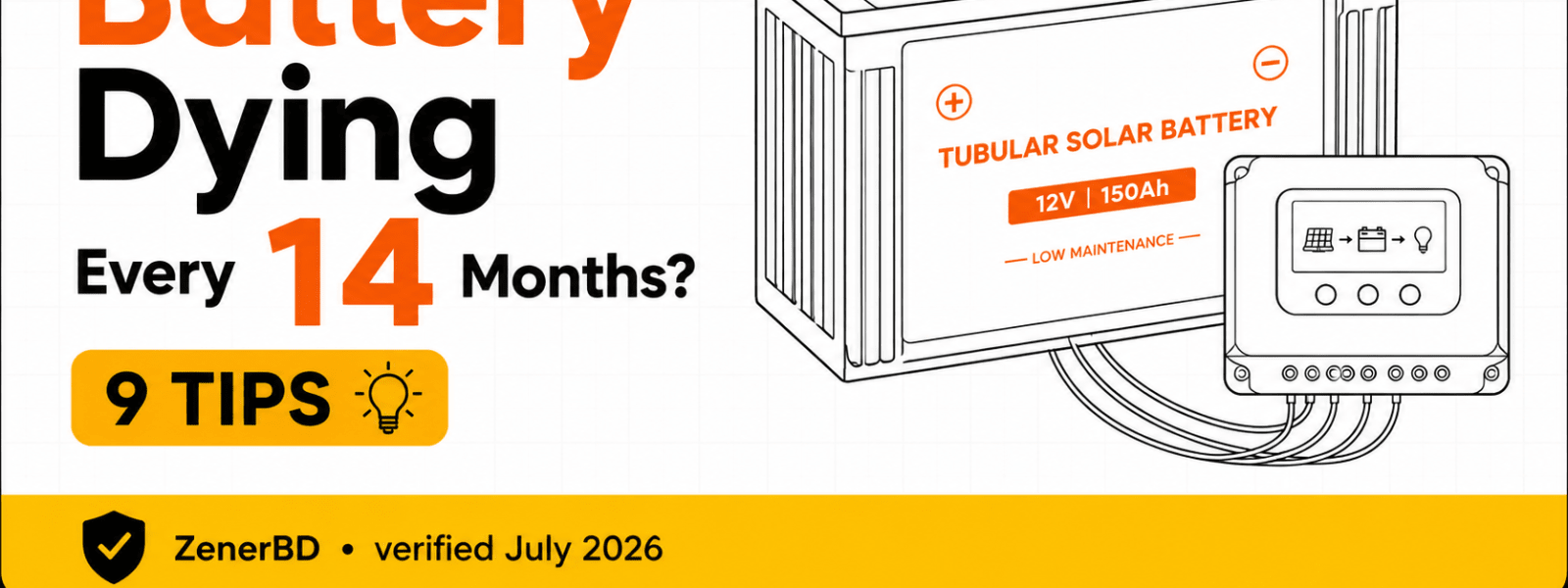
Solar Battery Dying Every 14 Months? 9 Tips That Actually Double Its Life in Bangladesh
Solar Battery Maintenance BD: 9 Tips to Double Life
Your tubular solar battery was supposed to last 4 years. Instead, it’s dying at month 14, and the shopkeeper is already trying to sell you a replacement. Here’s the hard truth: roughly 70% of early battery failures in Bangladesh aren’t manufacturing defects—they’re maintenance mistakes. The good news? You can fix most of them today for zero taka. Start with this: check your charge controller’s float voltage right now. If it’s below 13.6V for a 12V tubular battery, it’s undercharging and causing silent sulfation. Bump it to 13.6V–13.8V, and you’ve just bought yourself 6 extra months of life.
Written by Solar & Power Systems Team, ZenerBD | Last verified: July 2026 | Safety first: Skip tips #4 and #7 if you have a sealed AGM or Lithium (LiFePO4) battery—these rules apply strictly to flooded tubular/lead-acid batteries.
Quick-answer box:
Ideal Voltage: Set 12V tubular battery float to 13.6V–13.8V, boost to 14.4V–14.8V.
Water Rule: Top up only with distilled water, never tap water or acid.
Charge Rule: Never let it sit below 50% capacity for more than 2 days.
1. Set the correct charge controller voltage.
Why it works: Undercharging leaves lead sulfate crystals on the plates, permanently eating your battery’s capacity.
Do this today: Open your controller settings. For a 12V tubular battery, set the boost/absorption voltage to 14.4V–14.8V and the float voltage to 13.6V–13.8V.
The mistake: Leaving the controller on the factory "sealed" or "default" setting, which undercharges flooded batteries.
Pro move: If your controller has a temperature sensor, attach it to the battery terminal. It will automatically lower the voltage on hot Dhaka afternoons to prevent boiling.
2. Top up with distilled water only, and at the right time.
Why it works: Tap or tube-well water in Bangladesh contains minerals and chlorine. These coat the lead plates, blocking the chemical reaction.
Do this today: Check the water level every 3 months. Add distilled water only after the battery has reached a full charge, filling just above the plates.
The mistake: Topping up with tap water, adding acid, or filling it to the absolute brim (it will overflow and corrode terminals).
3. Never let it sit below 50% charge.
Why it works: Deep discharge accelerates plate degradation. A battery drained to 20% regularly will die twice as fast as one drained to 50%.
Do this today: Run heavy loads (like a fridge or large TV) only when the sun is out or your battery indicator is above 60%.
The mistake: Running a 1-ton inverter AC or a large fridge all night on a half-charged battery, then wondering why it’s dead by morning.
4. Clean the terminals and apply petroleum jelly.
Why it works: The white crust (corrosion) on your terminals increases electrical resistance. Your inverter has to work harder, wasting energy as heat.
Do this today: Mix baking soda and water. Scrub the terminals with an old toothbrush, wipe dry, and coat heavily with Vaseline (petroleum jelly).
The mistake: Ignoring the crust or using regular grease, which attracts dust and moisture.
5. Keep the battery in a shaded, ventilated space.
Why it works: Heat is the silent killer. For every 10°C above 25°C, a lead-acid battery’s lifespan is cut in half.
Do this today: Move the battery out of direct tin-roof sun. Ensure at least 2 inches of air gap around the battery casing.
The mistake: Boxing the battery tightly inside an unventilated wooden cabinet to "hide" it.
6. Match your load to the battery’s Ah rating.
Why it works: A 150Ah battery cannot magically power a 1-ton AC. Physics applies.
Do this today: Calculate your usable watt-hours. A 12V 150Ah battery holds 1,800Wh total, but you should only safely use ~900Wh (50% depth of discharge).
The mistake: Overloading the system and blaming the battery when it dies in 45 minutes.
7. Don’t use a cheap IPS charger to "fast charge" your solar battery.
Why it works: Many basic IPS chargers use unregulated, high-voltage spikes that boil the electrolyte and warp the plates.
Do this today: Rely on your solar charge controller (preferably MPPT) or a dedicated smart battery charger for grid top-ups.
The mistake: Plugging the solar battery into a ৳5,000 local IPS for "quick charging" during load shedding.
8. Equalize charge once every 3 months.
Why it works: Equalization is a controlled overcharge that breaks up early sulfation and balances the voltage across all 6 cells.
Do this today: If your controller has an "Equalize" function, trigger it for 2 hours on a bright, sunny day when the battery is already near full.
The mistake: Never equalizing, allowing acid stratification (heavy acid sinking to the bottom) to set in.
9. Buy a battery with a real warranty, not a "5-year" sticker.
Why it works: The local market is flooded with rebuilt or mislabeled batteries. A true 150Ah tubular battery costs around ৳18,500–৳20,000 in 2026.
Do this today: Check the laser-etched manufacturing date code on the casing. Buy from authorized dealers (e.g., Rahimafrooz, East West, Rimso).
The mistake: Buying a "150Ah" battery for ৳12,000 from an unknown brand and expecting it to last 4 years.
Mistakes that quietly kill it:
Using tap water (minerals = permanent capacity loss).
Storing a flat battery during Eid travel without a trickle charger.
Ignoring the "Low Voltage Disconnect" (LVD) alarm and forcing the TV to stay on.
If you’re tired of guessing whether your setup is sized right, we’ve pre-configured kits for 2-room and 3-room Dhaka flats that include properly matched tubular batteries and MPPT controllers. Check our Solar Home Battery or use us for a free load calculation.
A ৳50 bottle of distilled water and a 2-minute voltage check will save you a ৳20,000 battery replacement.
Frequently Asked Questions
3 answered questions
Zener Editorial Team
Editorial Team
The official editorial desk of Zener Bangladesh — covering solar, gadgets, tools and home appliance guides, installation tips, and engineering deep-dives.